
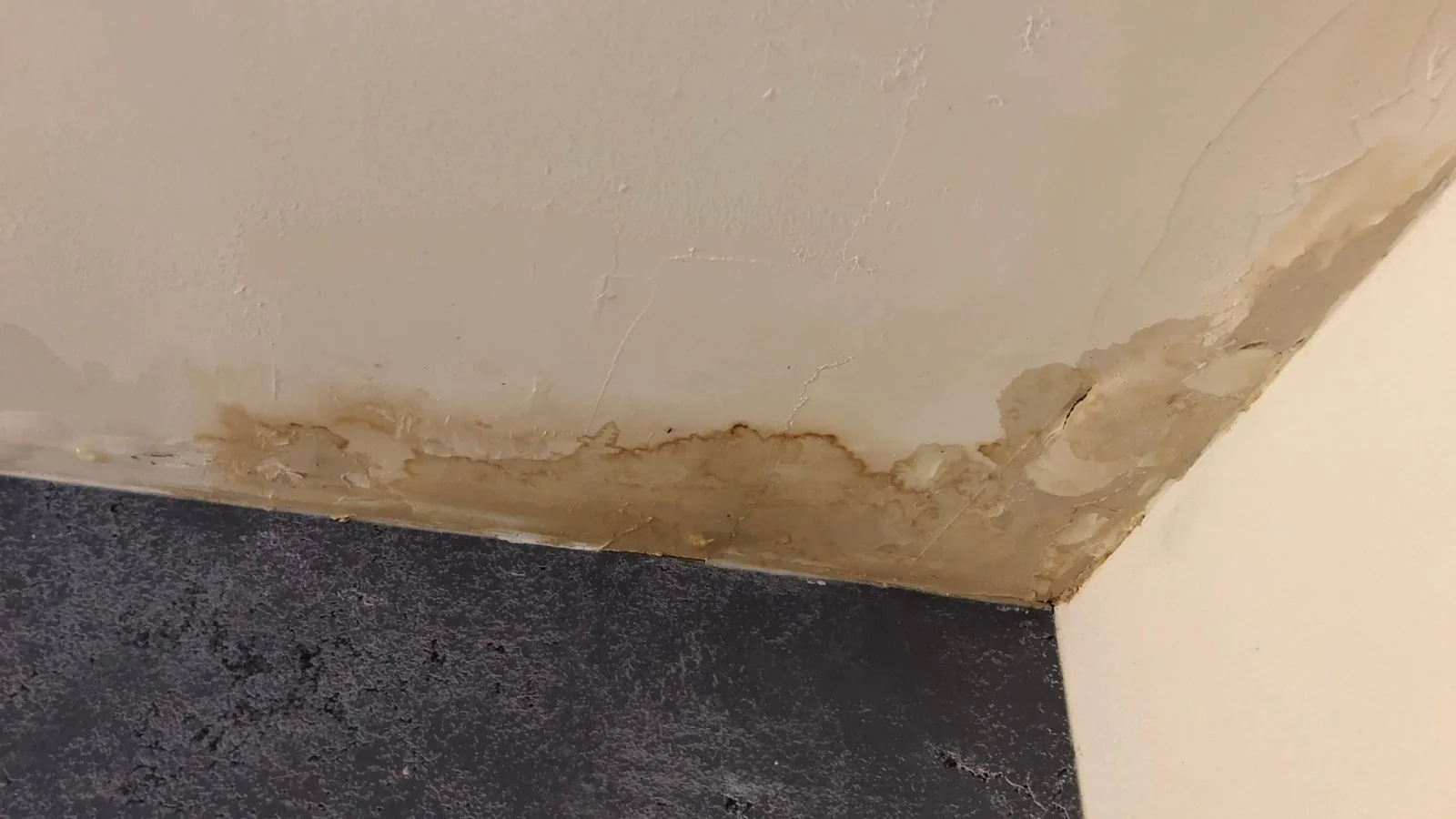
A slab leak is a leak in a water line that runs under or inside a concrete slab foundation, and the damage it causes shows up on the floor above. If you think you have one, treat it as an emergency. The line is answered 24/7, and the safest first step is to close the main shutoff and watch the meter.
This page only applies if your home is built on a slab. Whether yours is depends on the house, so ask a plumber or check your inspection report rather than assuming. If you have a basement or a crawl space, the same symptoms usually point to different causes, and the crawl space water damage and basement water damage pages are better places to start.
Warm spots, a hissing sound and a water bill that does not add up
Most people do not search for the words slab leak. They search for what they notice. A floor that feels warm in one spot, carpet that is damp with no obvious source, baseboards that are swelling, a hissing sound when everything is off, or a water bill that jumped for no reason are the usual signs.
If you see those, there is a simple test. Turn off every fixture and appliance that uses water, then look at the water meter. If the dial or the low-flow indicator keeps moving, water is leaving the system somewhere. That is a reason to call a plumber or a leak detection specialist, and it is a reason to call us if water is already in the house.
Check the meter
With all water off, a moving meter means a leak somewhere between the meter and the fixtures.
Close the main
This stops the loss while you sort out the source. Your water heater will keep its stored water.
Pull back the carpet edge
Lift a corner in a damp room. Wet pad or a wet slab confirms that water is arriving from below.
Call and document
Take photos of stains, swelling or buckled floors, and note when you first saw them.
Water under a slab and what it does above it
Water from a line under a slab has to find a path up. It travels along the slab, through control joints, and through gaps where walls meet the floor. It wicks into the bottom of drywall, soaks carpet pad, and lifts floating floors and hardwood from below.
The damage is slow and hidden, which is why it often gets bigger before anyone notices. Dried carpet may smell musty days later. Hardwood may cup. Baseboards may stain from the bottom up.
The line is answered around the clock. Call and describe what you see.
Finding the leak and drying what it wet
Locating a slab leak is a plumbing and leak detection job, and it can involve electronic listening devices, pressure tests and, for repair, breaking out a piece of the slab or rerouting the line. Restoration begins when the water is controlled.
| Stage | Who does it | What it involves |
|---|---|---|
| Find the leak | Plumber or leak detection company | Listening gear, pressure tests, access |
| Stop the loss | Plumber | Repair or reroute the line |
| Extract and dry | Restoration crew | Remove wet pad, dry slab surface, dry wall bottoms |
| Repair | Flooring and drywall trades | Replace what could not be dried |
We will say honestly when the next call you need is to a plumber. Drying a floor over a line that is still leaking only repeats the damage. When the leak is fixed, structural drying brings the moisture readings back down, and the hardwood floor page explains what happens to wood floors that took water from below.
Our drying and removal work follows the ANSI/IICRC S500 standard for water damage, which sets out water categories and the readings that show a material is dry.
What affects the cost
We explain the scope and how it is priced before work starts. For a slab leak the factors are:
- How long the leak has been active before it was noticed.
- How much of the floor and wall base is wet.
- What the flooring is made of.
- How many drying days are needed.
- Whether the slab or lines need repair, which is a separate plumbing cost.
Insurance for slab leaks can be complicated, because policies treat slow, hidden leaks and sudden failures differently. Ask your insurer exactly how your policy treats this, and ask what documentation they want. Want your real number? Call the line.
Questions about slab leaks
What does a slab leak feel like?
Typical signs are a warm spot on the floor, a hissing sound when water is off, damp carpet or baseboards, and a higher water bill.
Do you handle slab leak emergencies at night or on weekends in New Bern?
Yes. The phone line is open 24/7. Close the main and call, and note where the water is showing.
Do you repair the pipe under the slab?
No. A plumber or leak detection company does that. We dry and restore the structure afterward.
Can I tell if my house has a slab foundation?
Your inspection report, plans or a plumber can tell you. If you have a crawl space or basement, a slab leak is not the usual cause of wet floors.
Will insurance cover it?
Coverage depends on your policy and on whether the leak was sudden or gradual. Ask your insurer before repairs begin.
Call the 24/7 line and describe the damage in your own words.