
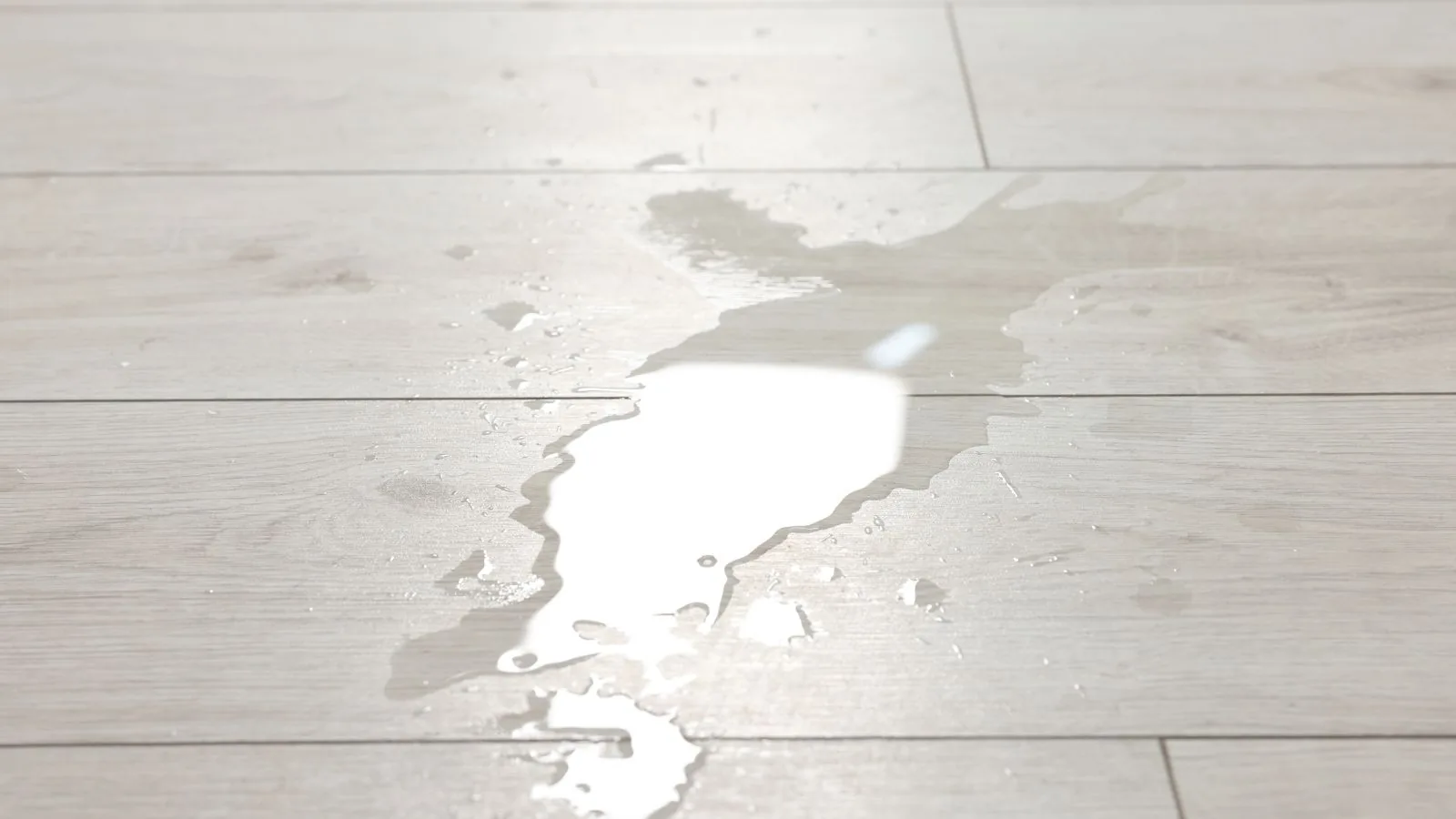
Kitchen water damage is what happens when a sink, supply line, dishwasher connection or drain lets water into cabinets, counters and flooring. Kitchens carry more plumbing in a small footprint than any other room, which means leaks happen, and they hide. This page is about the room itself and its materials, meaning cabinets, countertops, toe-kicks and floors.
If water is still flowing, close the shutoff valve under the sink or the main and call the line, which is answered 24/7. If the leak has stopped and you are dealing with swollen cabinets or damp floors, the steps below apply.
What a wet kitchen looks like
Most kitchen water damage shows up as swelling or discoloration at the base of cabinets, where particleboard soaks up water. Floors may look fine on top while the subfloor is damp. A musty smell near the sink, a soft spot under your foot or dishes that smell odd are all hints that water has been present for some time.
A good first check is simple. Empty the cabinet under the sink, dry what you can, and look for staining on the back of the cabinet floor. If you see dark marks, fresh swelling or rust on the fittings, the leak is probably older than you thought.
Shut the valve
The shutoff under the sink stops the supply to the faucet. If there is none, close the main.
Empty the cabinet
Remove cleaning products and dishes so you can see the base, and so the cabinet can dry.
Do not run the dishwasher
A leaking drain line makes more water every cycle.
Photograph the base
Photos of swollen panels and stained floors help with the claim.
Cabinets, counters and flooring
Cabinet materials vary. Solid wood and plywood often survive a wetting if dried quickly. Particleboard and medium-density fiberboard swell and rarely recover. Laminate countertops can delaminate at the edges. Tile floors can be fine, but the subfloor beneath may need drying.
| Material | After water | Usual outcome |
|---|---|---|
| Particleboard cabinet base | Swells, crumbles | Often replaced |
| Plywood or solid wood | May survive | Dried in place if caught early |
| Laminate countertop edge | Peels | Often replaced if the substrate swelled |
| Vinyl or laminate floor | Seams lift | Case by case |
| Tile with subfloor below | Tile fine, subfloor wet | Subfloor dried, grout checked |
How we dry a kitchen
Crews extract water, remove toe-kicks to open the cavity, and use moisture meters to check the cabinet bases, the walls and the floor. Small holes may be drilled to dry cavities behind cabinets without removing them, and air movers and dehumidifiers run until readings come down.
The goal is to save what is dryable and remove what is not, so you can plan repairs once, not twice. If the leak came from a dishwasher or a refrigerator line, the appliance leak page covers the appliance side. A wet floor beyond the kitchen is covered on the hardwood floor page.
The line is answered around the clock. Call and describe what you see.
Cabinets and toe kicks
The first sign of a kitchen leak is often a swollen toe kick or a cabinet floor that has turned soft. Particleboard cabinet boxes swell when they stay wet and rarely return to shape, while solid wood and plywood tolerate water better.
A crew can often dry behind the toe kick and under cabinets by removing a kick board and drilling small access holes. If a box has swollen, replacing that cabinet may make more sense than trying to save it.
Our drying and removal work follows the ANSI/IICRC S500 standard for water damage, which sets out water categories and the readings that show a material is dry.
What affects the cost
We explain the scope and how it is priced before work starts. For a kitchen the factors are:
- The size of the wet area and whether it reached the floor beyond the cabinets.
- Cabinet construction, which decides how much can be dried.
- Flooring type and underlayment.
- Drying days.
- Repair or replacement of cabinets, counters and floors.
Insurance depends on your policy and on the cause. Sudden leaks are often treated differently from slow seepage over time. Ask your insurer what they need, and keep receipts for any plumbing repair. Want your real number? Call the line.
When to bring in other trades
A plumber should fix a leaking line before drying finishes. A cabinet installer or contractor can quote the rebuild, and we can document the loss. Calls come from houses and apartments in the city and from Pollocksville and nearby, and the process is the same.
Kitchen water damage questions
Can swollen cabinets be saved?
Plywood and solid wood often can, if they are dried quickly. Particleboard usually cannot.
Will the floor under the cabinets be wet too?
Often, yes. Water travels under cabinets, and moisture readings tell the story.
Do I have to remove the countertop?
Not always. Many jobs dry the cavity without touching the counter, but a delaminated or swollen edge may need replacing.
Can mold grow in a wet cabinet?
Yes, if the materials stay damp. Quick drying reduces the risk.
Will insurance pay?
Your policy and the cause decide. Call your insurer and ask.
Call the 24/7 line and describe the damage in your own words.